Litigation is about creating a moment of accountability. Policy is about changing the direction of the future. My career has been built on understanding the difference — and on knowing how to produce both.
Effective policy work starts before the law does. It requires a well-tuned instinct for identifying the right problems — the ones that are real, that government can actually reach, and that are causing quiet, systemic harm to people who have no obvious recourse. At the CFPB, that meant designing the supervision strategy that protected millions of borrowers when federal student loans returned to repayment, developing the novel legal theory that pushed USDA to eliminate junk fees on school meal transactions, and drafting the federal court pleadings that defended the SAVE repayment plan.
The through line is method: find the problem worth solving, use every tool the system makes available, and build something that works even after you've left the room.
Charged on School Lunches

Payment processors have exploited a loophole in federal policy to charge K–12 families an estimated $100 million per year in fees just to manage their child's school meal account. Parents incur a transaction fee of approximately $4 every time they add money to their student's account.
While parents may appreciate the ease of managing and tracking their student's account, many are often unaware that there are fee-free methods of doing so. Lower income families also bear an inordinate share of the fees because they add money more frequently as they cannot afford to add large lump sums to avoid the transaction fees.
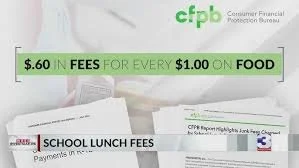
At the CFPB, I devised a multi-pronged legal and advocacy strategy to curb these junk fees:
- Cited a major market player for a Dodd-Frank violation for misleading families about the fees they charge
- Released industry guidance warning that these kinds of junk fees may violate federal consumer finance law
- Compiled a market report on the issue quantifying the real cost burden on families
- Made policy recommendations to the US Department of Agriculture to close the loophole that allowed these fees on school lunches
- Leveraged the eventual release of the industry guidance and market report to force the USDA to tighten policy allowing these types of abusive fees
The project became one of the first national spotlights on junk fees in K–12 systems.
- Significant national press coverage of our report drove broad public awareness and reframed the school meal fee issue as a consumer protection and equity issue
- The U.S. Department of Agriculture revised national school lunch program policy to completely eliminate these types of fees for low-income students
- $100 million in annual fees brought under scrutiny — with ongoing pressure to eliminate them entirely
Families are often told that fees are simply the cost of using modern services. But in this case, the charges were several times higher than the actual cost to the provider, which added little value in return. That isn't cost recovery — it's profiteering.
This project reflects how I approach hard problems:
There is still much to be done on this issue. Several of the entities that charge these fees have recently reformulated their fees to make them even more abusive. I have ideas how non-profits, parents, funders, technologists, and regulators can help. If you are interested in helping stop these junk fees for good, let me know.
Let me know →